Wednesday, November 15, 2017

Who'd like to visit Guatemala? HOLLYWOOD and Blake would too.

November 8-15

 When Holly and Blake came to visit us,
what a week it turned out to be!
We rode horses up Volcan Pacaya.

The entire afternoon,
 this active volcano loudly rumbled, roared and spat ash into the air.

At one point, the horse trail ended; we dismounted
and stumbled on foot across a relatively recent lava flow. 

We eventually found an open vent seeping up through the coarse black rock.
Hot air belched out. There, the guides provided marshmallows and roasting sticks.

The marshmallows were yummy.

Once, the volcano growled so ferociously, we all looked up expecting
to see huge lava rocks pour down on top of us. Yikes!

The volcano's indigestion, however, only burped up hot gases
and billowing white clouds. As we slowly rode
back down the mountainside to base-camp, we all realized
what an amazing experience this had been.
Thank you, Pacaya.
That night, we ate at a local restaurant named "Tacontento."

We ate tacos until we almost popped, but we were
very "contento."

The next day we took a three hour trip to beautiful Lake Atitlan,
stopping at ancient Mayan ruins -
a place called Iximche (ee/shim/shay).

Holly and Blake took time out to relax on the stairs
leading down to the ball court.

They had a fun time in the ancient ruins.

We reached Solola in the late afternoon.

At dusk, we arrived at huge Lake Atitlan.
This sunset photo was taken from our
hotel room window in Panajachel.

The downtown streets there are lined, block after block, with local merchants
selling everything from trinkets to food. Holly had fun shopping.
Blake just kept checking his pockets to see if there was any money left.
Holly shopped until Blake dropped.

The next morning we traveled by boat to the surrounding villages.
From our boat, we saw Fuego erupt in the distance.

In San Juan, we rode in "tuk-tuks."
We saw the  outside of the old Catholic cathedral...

 and the inside..

As we traveled throughout the towns,
we looked for needy women with young children
so that we could donate baby kits to them.

In one "tienda," we watched a woman spin, dye, and weave fabrics.

Holly learned to hand-spin cotton.
At the next stop,
we watched another young girl grind cocoa
beans to make chocolate. Yum.

At the wedding mural, Holly chose Blake all over again.
Mom and daughter enjoyed an artist's shop.

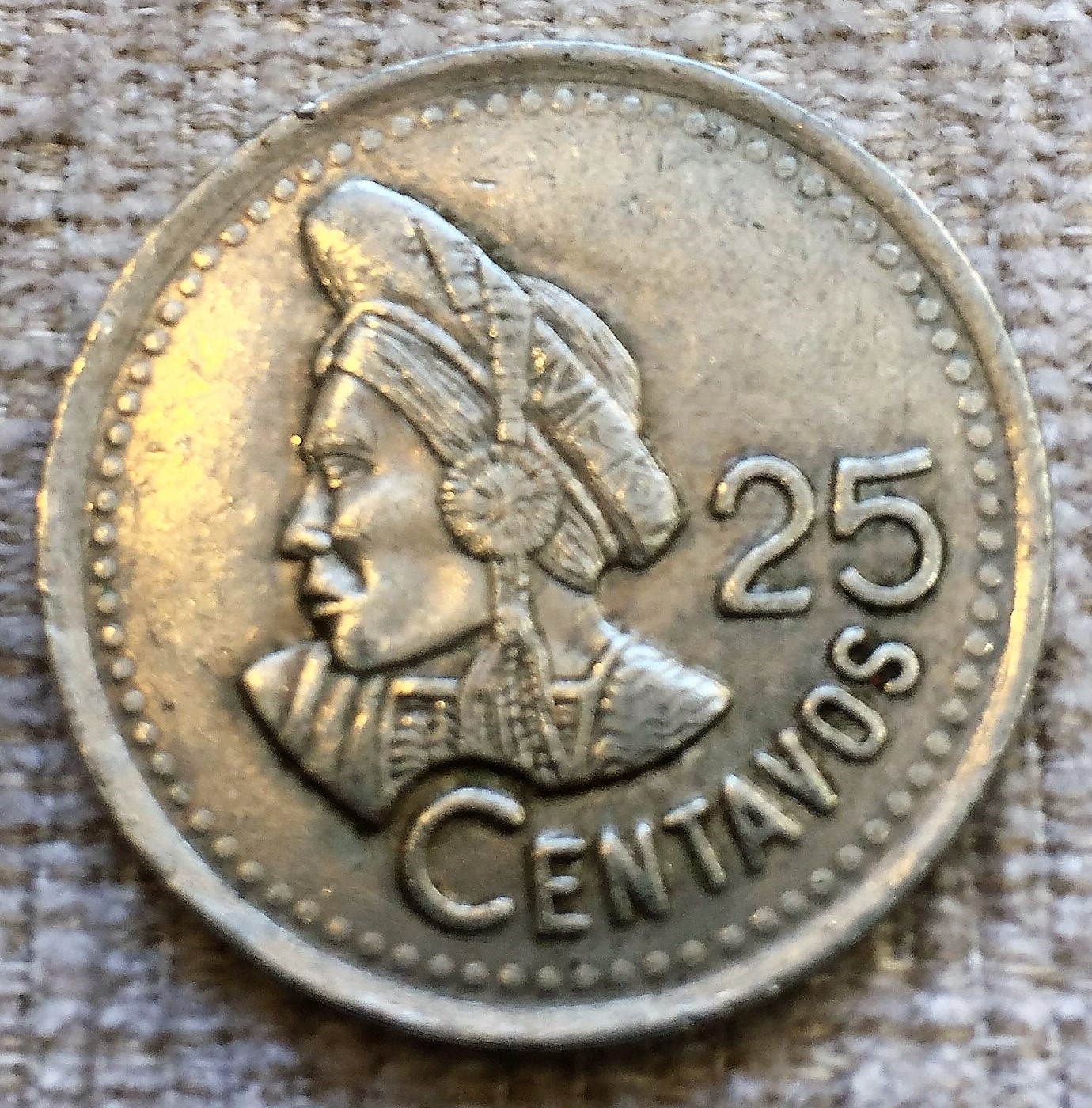
In the town of Santiago, we met this native woman who
is the actual woman depicted on the
25 centavo coin of Guatemala.

Cool, huh?!

On Sunday we attended an English speaking conference
near the Guatemala City temple.

Monday morning, we traveled this tree-canopied road
on our way to the Pacific coast.
We munched on lychee fruit that we had purchased
from a fruit stand in Esquintla.
The outside of this fruit looked hairy-scary...

...but the inside tasted candy-sweet.

When the road ended abruptly, we boarded
a two-car ferry to float down the river.

Good bye! We hope we don't all drown.
At Hotel Dos Mundos in Monterrico, we
relaxed in the sun.


 The hammocks were comfy.
From the "infinity pool," we watched the crashing ocean waves. 
The virgin pina coladas were crazy good.

Holly loved releasing baby sea turtles into their home in the ocean.
We all had fun with the baby turtles,

From our hotel, "Dos Mundos," (Two Worlds)
we saw two suns.

On our way back from Monterrico,
we passed the historic architecture of Antigua.

On November 15, while Holly and Blake were waiting
in the departing airplane, they watched as Volcano Fuego
offered a final goodbye salute, sending a mile high column
 of smoke and ash into the sky.
During their stay, we had seen erupting volcanoes, a motorcycle accident that happened right in front of us, and two murdered bodies still lying in the street along with bullet casings. We had survived Guatemalan traffic, narrowly missed gang violence and lived through a boat ride across the lake with waves taller than the boat. Yup. We think Holly and Blake got a real taste of Guatemala.  And we think they also had fun.


Tuesday, October 31, 2017

Fun Times, Fun Friends


Because Guatemala City could become a very dangerous place at night, as missionaries we were told to be home before dark. Other than an occasional trip to the temple or an extra long day at work, we didn't leave our neighborhood and rarely left our apartment building after sundown (about 6 p.m.). So, how did we spend the long evenings? Take a look:

We composed and sang songs about each other.
Back row: LaFaunda Curtis, Mark Curtis, Nancy Jackson, Byron Jackson, Tony Reyna
Front row: Dee Whittier, Jay, Larry Hogg, Shaun Hogg, Margo Reyna

We performed for each other,
Jay, SusAnn McLemore, Marc McLemore, Margo Reyna, Tony Reyna


We fed each other.
Front: Marylou Whittier with her famous pies
Back: Rick Jergensen, Dan Johnson

We chatted with each other. (This conversation looks serious!)
Dee Whittier, Dave Oyler, Larry Hogg, Susan Oyler
We had Family Home Evenings with each other.
SusAnn McLemore, Nancy Frampton, Robert Frampton, Ellen Clason, Lonna Jergesen, Jeff Clason

And we dressed up and partied with each other.
Marc McLemore, Jay, Trudy, Margo Reyna, Tony Reyna, LaFaunda Curtis, Mark Curtis

Yup. Guatemala City could become a very scary place at night. (Especially if that night was Halloween.)

SusAnn McLemore, Marc McLamore
LaFaunda Curtis

LeeAnn Johnson, Dan Johnson

Shaun Hogg, Larry Hogg
(He made those teeth for this special occasion. What a  dentist!)

Jeff Clason, Ellen Clason

And the winners are...

The monster in the dryer who eats your socks
A handsome knight
(or is that night?)


Saturday, September 30, 2017

Meet Some of Our Patients

Maria
September 2017
maria.jpg
Many of our patients come from humble homes where parents are forced to choose between providing food for their families or acquiring dental care for them. When this happens, children are taught to endure nightmarish tooth pain without complaint. By the time these children come to see us as teenagers, their mouths show the effects of years of dental neglect.


When Maria came to our clinic, she required multiple appointments in order to be able to serve a mission. On separate occasions, Dr. Hogge, Dr. Harris and Dr. Jergensen each worked on her teeth for donated treatment that, in the United States, would conservatively cost between five and six thousand dollars. Maria’s father supports his family of seven by working in a bakery. To pay for this kind of treatment would be an impossible dream.

We feel it is a privilege to help young future missionaries like Maria, and know she will be a marvelous missionary because her example has already brought others to Christ. When she was ten years old, she and two siblings joined The Church of Jesus Christ of Latter-day Saints. Over the next five years, the rest of her family members were baptized. When asked why she now wants to serve a mission, Maria’s answer was simple, “Because I am so grateful.”


Nelson, Mario, Wilma, and Sergio
September 2017

Coban missionaries.jpg

Not all of our patients speak fluent Spanish. These four future missionaries live in a remote village near SenahĂș / Nauq’, Guatemala. Their native language is Q’eqchi. They traveled eight hours to reach our clinic, experienced difficult dental procedures, then cheerfully made the eight-hour return trip home. Why did they make this sacrifice to serve missions?  

Nelson answered this question by saying that he wants to, “bring more souls into God’s presence.”

Mario’s goal is to “spread the gospel.”

Wilma wants to “invite people to come to Christ.”

Sergio summed it up by saying that he “just wants to help our Father in Heaven.”

Sunday, September 17, 2017

Volcanoes, Snails, and Cotton

On a recent weekend, we traveled to Lake Atitlan in Guatemala. Crossing the large lake by boat, we stopped in one of the villages along the shore. Each town is named after an original apostle. This village is named San Juan (Saint John). You can look across the lake at the distant volcanoes. All but one is dormant now, but the history of this lake has to be one of turmoil, upheaval and probably death to anyone living nearby.


As we walked along the pier, we watched as a native woman in her tipica blouse and skirt, up to her knees in the water, slowing overturned submerged rocks as if looking for something. We were informed that she was collecting tidbits for dinner. Apparently snail soup is on the menu tonight.


We climbed the steep, shop-lined street, searching for bargains, and enjoying the gorgeous surroundings.

We visited a local shop that sold items made of cotton fabrics, items such as sweaters, table runners, scarfs and carrying bags. One of the vendors offered to show us, from start to finish, the production process. She explained that it all begins with a seed-filled, armful of hand-picked cotton. Once the black seeds are carefully removed, a pinch of cotton is drawn out into a long, consistently thin string of delicate cotton thread. The thread is slowly wound around a wooden, tapered spool. Trudy volunteered to demonstrate the tedious process for us. I was amazed at how well she did. She's a natural!


Next the cotton thread is dyed. This ancient process of dying uses all kinds of natural flower petals and plant roots and crushed plant leaves, each with a different, distinct color base. They even use dried up bugs! What do you think they use for orange dye? Yes, if you thought "carrots," you're right!


Now, a fascinating fact, the women of San Juan La Laguna pick the leaves of a certain plant called Sacatinta, which in English means "to extract color." From those leaves, the women get a light grayish-blue dye for their fabrics. However (and this is the fascinating part) if they harvest those same leaves on the night of a full moon (ewww scary) the dye color turns an intensely rich shade of navy blue. I swear! I'm not kidding! Apparently, the chemistry of the plant is changed so that it results in a totally different shade of blue. Cool, huh?

See the two colors. Amazing!
The native women soak the thread in the specific dye, then boil the thread in banana stalk soup for about an hour to totally set the permanent color into the yarn. Someone, a long time ago, I'll bet from trial and error, figured all of this stuff out!

Look at all the different colored yarns
Next, they stretch the yarn.


And finally begin the weaving process. All is done by hand.


Not just hours, but days go into each weaving project. Then the goal is to sell these items on the street, often for merely a dollar or two.  I really came away with an appreciation for how hard these women work, and how little they earn in return.


Friday, September 15, 2017

A Trip Home

In September, we made a trip back to the USA for Carly's baptism and a required medical check-up for Jay.


We were able to see everyone in our family except McKay, who was in Costa Rica serving his own mission.


Anson, Bella, Sofiya, Mark, Christy, and Hayden
at the baptism
Harrison, Emily, Jackson, Carly, Christian and Sadie
at their home in Johnstown
Julie, Dax, Thomas and Zane
at the Sportsman Park
James, Kate, Grace, Isabelle and Will
in front of their new house
Nate with Pierre, Holly, Jessica, Kendra, Blake, Maddy and Paisley
at Mesa Falls

Elder Simmons
in Costa Rica
Jay, Trudy, Marie and Andrew
at their favorite Mexican restaurant
The trip turned out to be more stressful than we could have imagined. In the end, however, we felt like it was our Heavenly Father's plan for us to return to Guatemala to finish our missions. We were grateful when the authorities in Salt Lake cleared Jay's health and gave us permission to return to the mission field.
While in Idaho Falls, Jay's heart again went into A-fib.
Marie got to push the button to shock his heart back into rhythm.
Way to go, Marie!